Why Choose Laser Bird Repellent for Global Buyers?
Global buyers need bird-control solutions that are effective, practical, and responsible. Laser Bird Repellent systems use moving light patterns to discourage birds from entering sensitive areas. They do not rely on poison, traps, or physical contact. This makes them suitable for farms, warehouses, airports, solar facilities, and food-processing sites when properly assessed.
Real-world performance depends on more than the device itself. Product placement, bird species, weather, reflective surfaces, and operating schedules all matter. A system installed near a grain warehouse may need different settings from one used beside a fruit orchard. Professional suppliers should provide clear specifications, installation guidance, safety instructions, and maintenance support. Buyers should also confirm compliance with local aviation, wildlife, workplace, and laser-safety requirements before deployment.
The strongest purchasing decision combines field experience with realistic expectations. Laser deterrence may reduce bird activity, but it rarely solves every situation alone. Birds can adapt. Some locations may require rotation, monitoring, or additional non-harmful measures. This is where careful evaluation matters. Ask for test results, operating records, and references from comparable sites. Check whether the equipment performs during rain, bright sunlight, and low temperatures. Small details matter.
A reliable supplier should explain limitations, not hide them. That honesty builds trust. For global buyers, the best solution is not always the most powerful one. It is the system that fits the site, supports animal welfare, meets local rules, and delivers measurable value over time.
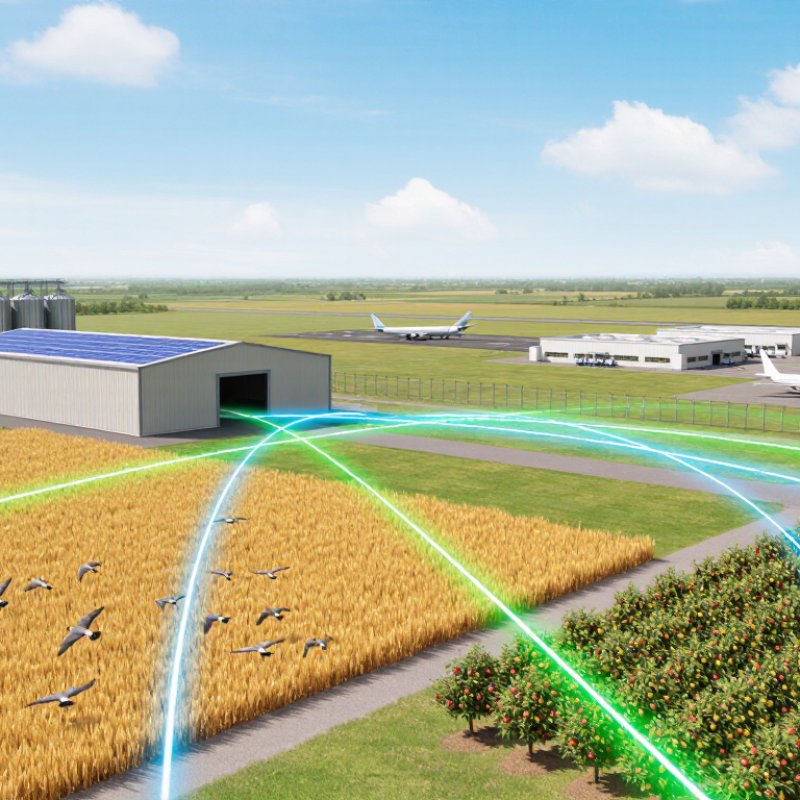
Laser bird repellent is a visual bird-management device that uses moving laser light to discourage birds from landing or gathering. It does not trap, poison, or physically attack them. The beam usually sweeps across fields, rooftops, warehouses, ponds, or orchards in changing patterns. Birds often interpret this sudden movement as an approaching obstacle or threat, so they leave before settling.
The system works best during low-light periods, such as dawn, dusk, or cloudy weather. A controller can vary the beam direction, speed, and operating schedule. This variation matters because birds may ignore a repetitive pattern over time. In practical installations, operators should aim the beam toward landing zones, not directly at birds or people. The laser must never point toward roads, aircraft paths, neighboring windows, or reflective surfaces. Local safety rules also deserve careful checking.
It is not a magic wand. Some species adapt quickly, especially where food remains plentiful. Field experience suggests combining laser use with cleaner storage, netting, habitat changes, or sound-based methods. Placement also needs regular review after rain, construction, or seasonal migration. A poorly adjusted unit may disturb people while protecting few surfaces. Reliable results depend on species behavior, site layout, weather, and responsible operation, not the device alone.
Laser bird repellent systems use moving beams of visible light to create a visual threat that many birds instinctively avoid. Green light is commonly selected because it is highly visible to the human eye and can provide strong contrast in outdoor environments.
The chart compares nominal wavelengths commonly associated with visible laser colors. Wavelength is a physical specification, not a guaranteed measure of bird-deterrence performance; results depend on bird species, weather, background contrast, beam movement, installation area, and operating procedures.
Bird pressure is rarely a local inconvenience. It can contaminate stored grain, damage crops, and create costly cleaning work. For global buyers, laser bird repellents offer a quiet, non-contact option for controlled areas. Moving light patterns can disturb birds and encourage them to relocate. No traps, poison, or repeated explosive noise are needed.
Practical field assessments show that results depend on site design and bird behavior. A device must cover roosting points, feeding areas, and regular flight paths. Fixed settings may work briefly, then lose effect. Birds can adapt. Not a magic solution. Buyers should review detection range, scanning angles, weather resistance, and maintenance requirements. An outdoor unit needs suitable protection against rain, dust, and strong sunlight. Operators should also avoid directing laser beams toward people, vehicles, aircraft, or nearby homes.
International purchasing adds technical and compliance concerns. Voltage compatibility, installation language, spare parts, and remote support can affect long-term reliability. Clear safety instructions are essential for every operator. Buyers should request test records, product specifications, and evidence of consistent manufacturing quality. Local authorities may regulate laser use, especially near transport facilities or public spaces. Site assessments should happen before installation. Results should be recorded through bird counts, photographs, and cleaning reports. Some installations may still need netting or habitat management. That limitation deserves honest attention.
| Evaluation Dimension | Typical Laser Bird Repellent Characteristics | Why It Matters to Global Buyers | Important Buying Consideration |
|---|---|---|---|
| Deterrence Method | Uses moving visible light to create a visual threat response and encourage birds to leave the protected area. | Provides a non-lethal option for farms, warehouses, airports, ports, solar facilities, and public spaces. | Bird species, habitat, food availability, and installation layout strongly affect results. |
| Light Wavelength | Many commercial systems use visible green light, commonly in the approximate 520–532 nm range. | A visible beam can be used during low-light periods without chemical residues or physical contact. | Confirm wavelength, optical output, beam divergence, and legal classification before import or deployment. |
| Safety Profile | Designed as a non-contact deterrent, with no toxic bait, poison, or chemical spray. | Can help reduce chemical exposure risks for workers, livestock, food-handling areas, and surrounding ecosystems. | Never aim the beam at people, vehicles, aircraft, reflective surfaces, or occupied buildings; follow local laser-safety rules. |
| Coverage | Coverage is determined by line of sight, beam visibility, sweep pattern, mounting height, terrain, and obstructions. | Suitable for targeted zones and perimeter protection where operators need flexible area control. | Do not judge coverage by laser range alone; verify the actual protected area and blind spots. |
| Operating Conditions | Generally most visible at dawn, dusk, nighttime, or under overcast conditions; bright sunlight reduces visibility. | Supports different operating schedules across climates and production cycles. | Review performance in fog, rain, dust, snow, and direct sunlight; environmental sealing may be required. |
| Automation | Systems may include programmable movement, timers, remote controls, sensors, or automatic scanning patterns. | Reduces the need for continuous manual patrols and supports large or remote sites. | Check timer accuracy, control interfaces, network compatibility, and manual override functions. |
| Power Requirements | Available configurations may use mains electricity, rechargeable batteries, or solar-assisted power systems. | Power flexibility is valuable for remote farms, coastal facilities, construction sites, and off-grid locations. | Compare operating voltage, battery autonomy, charging time, standby consumption, and backup power needs. |
| Maintenance | Routine care typically includes cleaning the optical window, checking mounts, inspecting cables, and testing controls. | A relatively simple maintenance routine can support consistent operation across multiple sites. | Ask for cleaning procedures, spare-part availability, service intervals, and technical documentation. |
| Weather Resistance | Outdoor units should provide suitable protection against rain, dust, humidity, and temperature variation. | Relevant for international buyers operating in tropical, desert, temperate, and cold environments. | Verify the enclosure rating, operating-temperature range, corrosion resistance, and wind-load requirements. |
| Bird Habituation | Birds may become less responsive to repetitive patterns, so varied movement and integrated deterrence methods are recommended. | Helps buyers plan longer-term bird-management programs rather than relying on one device alone. | Use changing scan patterns and consider combining visual, acoustic, physical, or habitat-management measures. |
| Compliance and Import | Requirements vary by country and may cover laser classification, electrical safety, electromagnetic compatibility, radio functions, and environmental protection. | Early compliance checks reduce customs delays, installation restrictions, and workplace-safety risks. | Confirm destination-country regulations, required documentation, labeling, user instructions, and installation permits. |
Note: Performance varies by bird species, site conditions, weather, installation design, operating schedule, and the use of complementary deterrent measures. Buyers should conduct a site assessment and verify all safety and regulatory requirements before installation.
Global buyers should judge laser bird repellent by measured performance, not bright appearance. The FAA Wildlife Strike Database recorded more than 19,000 reported wildlife strikes in 2023. This figure shows why airports, farms, and warehouses need tested control methods. A credible evaluation compares bird activity before and after installation. It also includes untreated control areas, observation time, weather, and species. One impressive trial is not enough.
Ask for data on detection range, scanning speed, coverage area, and operating hours. Field experience suggests that moving light patterns work better than a fixed beam. However, results can change with sunlight, fog, reflective roofs, and bird species. Request independent test records, not only laboratory demonstrations. The report should identify the sample size and reduction rate. Numbers without conditions are weak evidence.
Safety requires stricter checks. IEC 60825-1 classifies laser products by accessible emission risk, while the U.S. FDA’s Center for Devices and Radiological Health provides related performance requirements. Buyers should verify laser class, wavelength, beam divergence, interlocks, warning labels, and maintenance procedures. The system must avoid direct exposure to people, vehicles, aircraft, and nearby homes. FAA guidance on laser illumination near airports also deserves review. It is easy to overlook reflective glass. I would test the installation at eye level during commissioning, then repeat inspections after storms. No device eliminates every bird problem; habitat changes and food removal may still be necessary.
International buyers should compare performance, safety, and service before selecting a laser bird repellent. A visible moving beam can discourage birds from landing without loud noise or physical traps. However, results depend on bird species, site layout, weather, and nearby food sources. The longest claimed range is not always the most useful feature.
Check the laser’s operating class, beam control, detection method, and coverage pattern. The device should include clear safety instructions and prevent exposure to people, vehicles, aircraft, and reflective surfaces. Look for weather resistance, stable mounting, low power use, and reliable operation after rain or dust. For remote sites, solar charging and battery backup can reduce maintenance. Buyers should also compare test data, warranty terms, spare parts, and technical support in their region. Certifications matter, but they should match the destination market.
Tips: Ask for field evidence from similar environments. Test one small area first. Watch bird behavior for several days. A sensor may miss fast-moving flocks, while continuous operation can waste energy. I have found that simple controls are easier for site teams, though advanced settings can improve coverage. This is a real trade-off. Also, birds may return when food or nesting shelter remains nearby. Review installation guidance carefully, and confirm local requirements before deployment. Human oversight still matters.
Selecting and deploying a laser bird repellent starts with risk mapping, not equipment shopping. The FAA Wildlife Strike Database recorded 19,367 reported wildlife strikes at U.S. civil airports in 2023. Birds represented the overwhelming majority of recorded events in FAA’s 1990–2023 analysis. This figure reflects reporting quality, not every real incident. That limitation matters for global buyers.
Choose a system after identifying bird species, flight paths, light levels, and protected zones. USDA APHIS guidance states that laser hazing can move birds under suitable conditions. Results still vary by species, weather, and habitat. Select adjustable sweep patterns, weather-resistant housing, and built-in safety controls. Never aim toward roads, homes, towers, or aircraft. Install units near approach routes, roosting edges, ponds, and loading areas. Change timing and angles regularly. Birds can learn repeated patterns. A weak installation can look impressive and still fail.
Tips: Start with a seven-day baseline. Record bird numbers at dawn and dusk. Map roosting points and flight directions. Test one zone first. Compare weekly observations, strike reports, and maintenance logs. Combine laser deterrence with habitat management and trained monitoring. Do not judge success after one quiet morning.
